
The First Democratic Tech Alliance Assembly
Yesterday I attended the first assembly of the Democratic Tech Alliance (DTA), which gathered in the European Parliament. Membership of the alliance includes European political groups like the Greens/EFA, the liberal/center right Renew Europe, the European People’s Party of Christian democratic, conservative and liberal-conservative persuasion and also the Progressive Alliance of Socialists and Democrats.
This is a broad, quite sane and actually impressive collection of political groups, which gives me some hope. There are further members from civil society and industry as well, which is key, because the big-tech lobby can only be resisted through a broad front. Also, that we see such a broad alliance is indicative of the gravity of the situation. Things are not looking good for our democracies & the tech on which these are running.
The Democratic Tech Alliance has broad goals: “The Democratic Tech Alliance is a coalition of members from different political groups in the European Parliament, with civil society actors, think tanks, experts and European businesses working to create an EU tech ecosystem that supports democratic values and the public interest”.
Stated more bluntly, you don’t get to keep your democracy (or rule of law) if you are forced to rely on other people’s technology for your most basic functions. As noted by DTA co-founder EPP MEP Axel Voss “we have a lot of undemocratic situations and we have a timeline of 2-3 years to do something and that’s probably generous”.
Europeans get much of their news (and propaganda) through US controlled platforms, with the US stating they want to use their tech influence here to shape our policies to their wishes.
So this work is important.
What did we learn?
The assembly consisted of a members-only part, plus a public session hosted within the European Parliament. I only attended the second part.
In that second part, there were two panels. The first one, moderated by Sophie Bloemen (Commons Network, one of the co-founders of the DTA) also featured MEP Kim van Sparrentak:
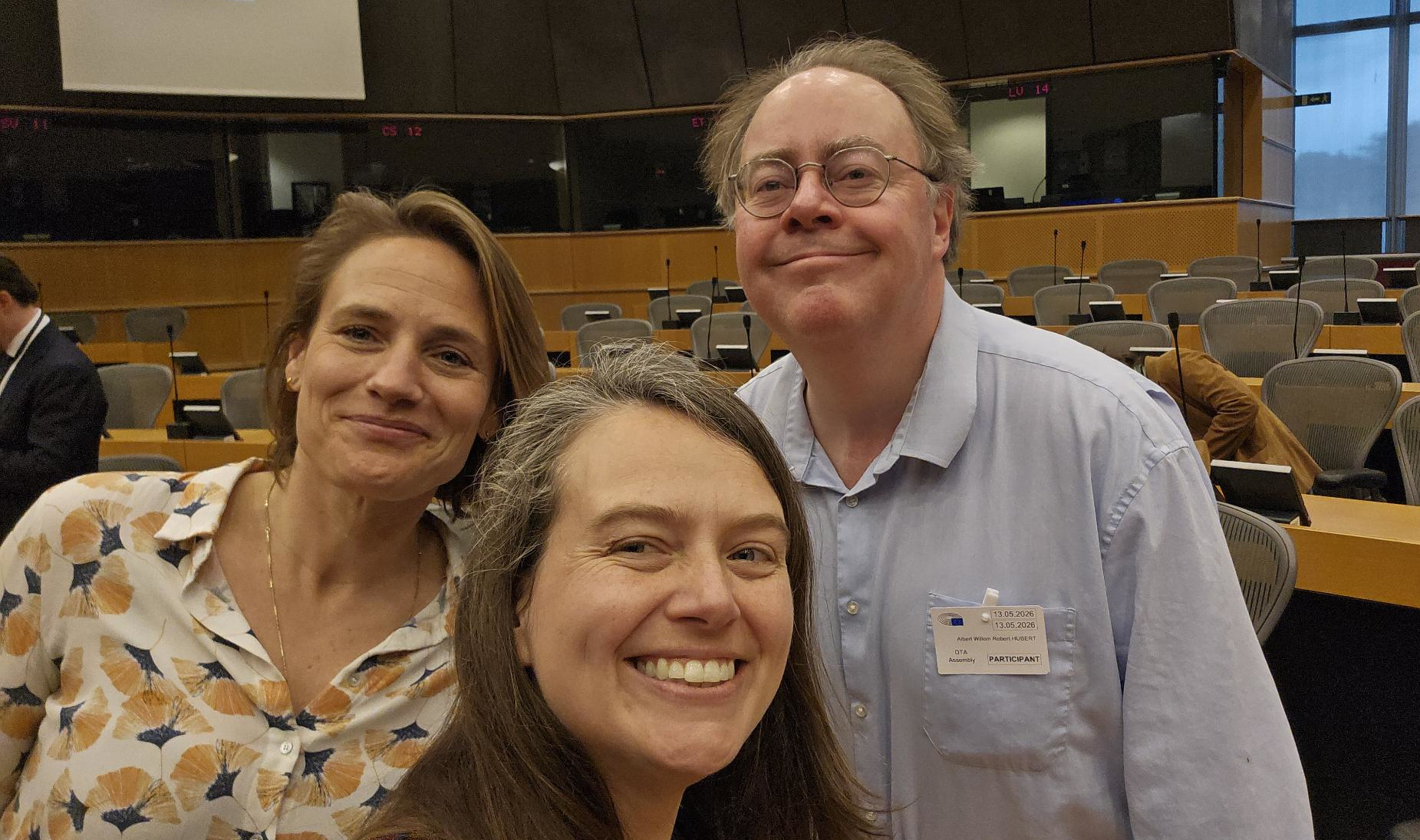
Sophie, Kim, me
I’ll be highlighting some things of note from the assembly, but this represents only my personal highlights, it is not a full summary. If I missed anything important, do let me know!
In the first panel, there was a noteworthy contribution from the Joint Research Centre, a nearly 3000 people strong organization that provides evidence-based knowledge to support EU policies and positively impact society. The JRC deserves much more attention than it gets, it is a prime example of the kind of thing that Europe can do by working together. No individual member state would be able to assemble so much brain power on its own, nor service the vast scope of subjects that the JRC covers.
During the assembly, the JRC did not disappoint when they presented their initial analysis of digital sovereignty (also read this report). Of note is this figure:
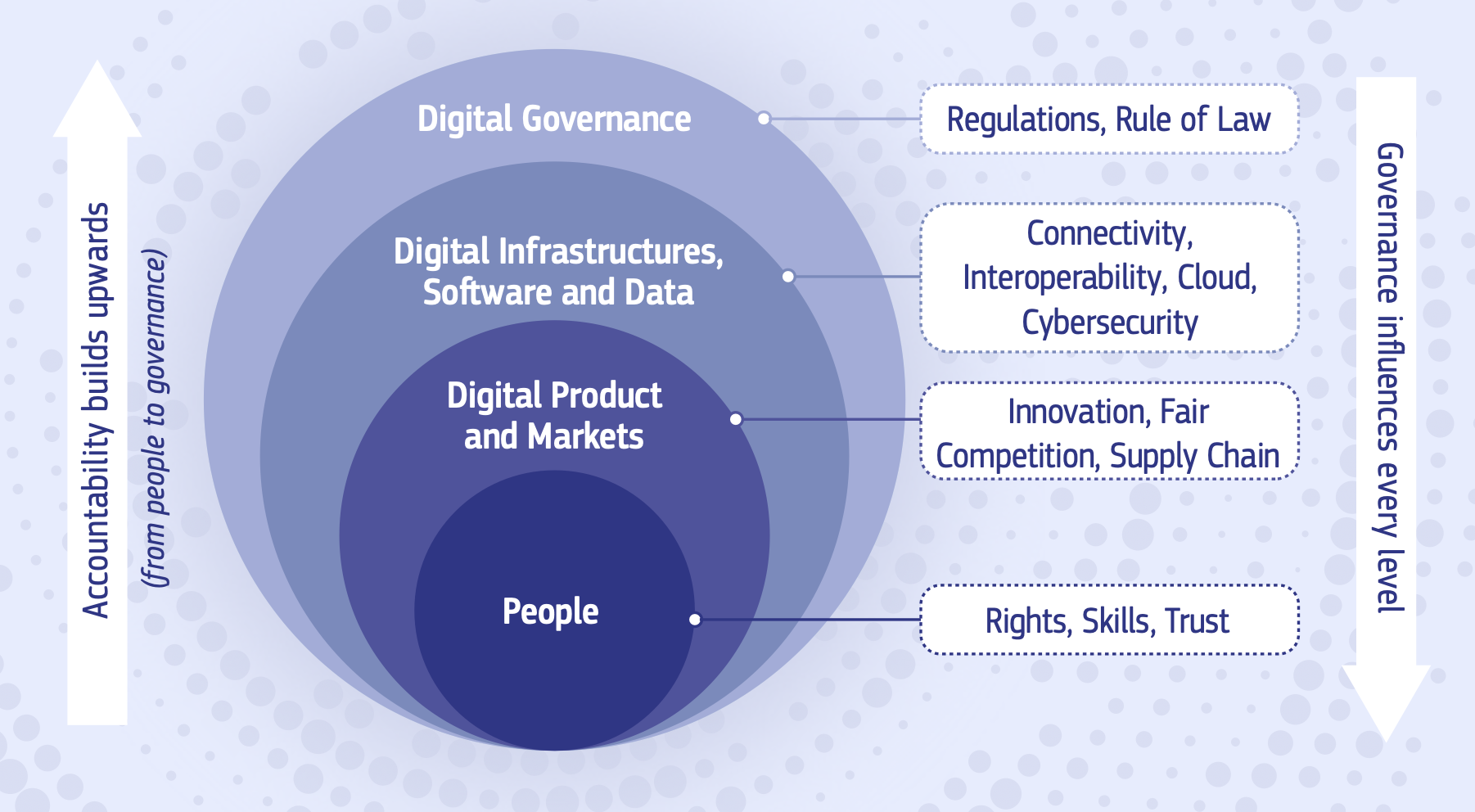
Note that the inner circle consists of “People”. Diletta di Marco of the JRC heavily stressed this part of the equation, and she is completely right. When we started the digital sovereignty discussions some years ago, we first had to get the whole thing on the agenda.
This was then followed by “there is nothing we can do” due to procurement rules. This is now being addressed. This was followed by there is no money, and here too progress is happening (for example, the commission €180 million tender for sovereign cloud, or the European Competitiveness Fund).
But still not a lot is actually happening, and this is in large part due to “people” concerns, where people includes senior politicians, civil servants, procurement professionals and importantly, the IT staff over at governments.
Moving away from standard US clouds for government services is a novel activity. It is full of risk. It means moving away from tried and trusted technologies & service providers. “People” are not naturally inclined to go against the flow. And, especially within governments where success is not celebrated (or rewarded), but failure most certainly gets noted.
If we want to make any progress, now is the time to start involving government staff that make actual decisions and get them on board. This goes down from relevant ministers to senior staff to heads of IT services and procurement groups. We desperately need to hear from these groups! Yet, they are almost never present or represented.
After the JRC presentation I conveyed my happiness with “people” entering the chat, and subsequent speakers and interveners took up this cause with some passion. I sincerely hope that we’ll be able to get the current “dark matter of IT decision making” on board with our discussions.
In further talks, we also covered that people very much includes end-users (so, all of us), who will have to put up with some friction as we move away from US big tech. Not all thousand Outlook and Team features will work the same way in the brave new world of digitally autonomous software!
Second panel
The second panel featured famous MEP Alexandra Geese, who held a fiery talk on that we in Europe actually do have a functioning cloud industry and that it is nonsense that we can only get our stuff from the US. She also noted that our stuff is actually cheaper too and can win on price.
While I appreciate the sentiment, her story is only “technically correct” as we geeks are fond of saying. In our circles, we sometimes even note that “technically correct is the best correct”.
The story is technically correct in the sense that indeed we have all the servers, database, storage and networking to deliver all services from Europe. The story is however incorrect in the sense that in Europe we have ample wood. But modern IT customers are not buying wood, they are buying furniture.
If you can deal with “quite some assembly required”, you can satisfy all your computing needs in Europe. But this is sadly not what the market is. I wrote about this earlier. Now, it could be argued that governments should not be basing their services on proprietary single-vendor pre-assembled solutions, and I would agree with that.
But for now, if we want to make progress, it is not helpful to overlook the difference between EU and US cloud service providers. If you want an attractive wardrobe, you expect the IKEA PAX system and not a lumberyard. And this true even if a skilled operator could build better cabinets out of high quality European wood. Earlier, I have written an exhausting amount of words (sorry) on what Europe does and does hot have, and what customers expect.
In the panel, the newly appointed director of the European Digital Infrastructure Consortium for Digital Commons Laurent Rojey also presented their ideas. Last year I presented over at the launch of this EDIC, where I offered some strong words on what should be done and I’m happy that there is now a director, and I hope they can make it happen.
Another interesting part of the panel was the presentation by Kasia Toczko of Simplito, a Polish company actually developing and selling tools for private AI on local infrastructure as well as platforms for implementing post-quantum end to end encryption.
Many panels are somewhat removed from practical software development or even commerce in general, and I hope future panels will continue to include the companies that make things happen in reality.
Rounding off
We concluded the day together with Defend Democracy’s “Democracy Drinks”, and this proved to be a great place to continue the conversation. There was a high density of relevant people, and I commend the Democratic Tech Alliance and Defend Democracy for convening us, and I have high hopes for future events!